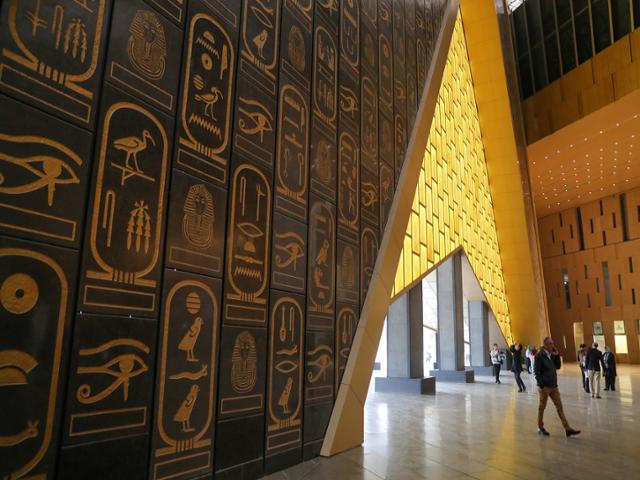
Delve into the rich tapestry of Egypt's history on a full-day tour exploring the Grand Egyptian Museum (GEM) and the National Museum of Egyptian Civilization (NMEC). This fascinating journey takes you from the ancient world to Egypt's vibrant cultural legacy.
Start your day at the Grand Egyptian Museum, the world's largest archaeological museum, located near the Giza Pyramids. Admire its stunning modern architecture and explore the treasures within. Highlights include the complete collection of King Tutankhamun's artifacts, showcased together for the first time, including his iconic golden mask and royal treasures. Wander through galleries filled with statues, mummies, and artifacts spanning millennia, all narrated by your expert guide.
After a break for a traditional Egyptian lunch, continue to the National Museum of Egyptian Civilization in Old Cairo. This museum focuses on the broader story of Egypt, from prehistoric times to the modern era. Marvel at its centerpiece, the Royal Mummies Hall, where ancient kings and queens rest in carefully preserved splendor.
This comprehensive tour combines two world-class museums, offering a unique opportunity to connect with Egypt's heritage through its most extraordinary collections. Perfect for history enthusiasts and cultural explorers alike!
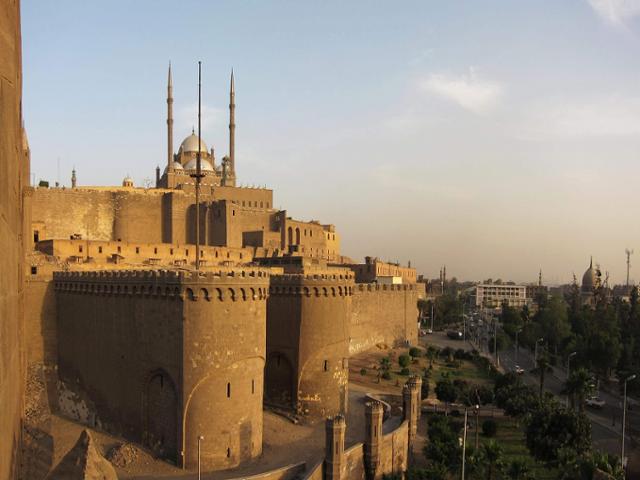
Join us on a special guided tour to visit one of the few remaining old Gates of Cairo Wall, which was built during the Fatimid period and is known as Bab Zewila. From the top of the wall, you will enjoy a breathtaking view of old Cairo. Afterward, you will continue the tour by visiting the tent market (khayamya), where you can shop for handmade special products.
The tour will then take you to the notorious Khan al-Khalili bazaar, where you can experience the classic Egyptian markets. Here, you will find a wide range of goods, from traditional clothing to jewelry and souvenirs. Enjoy bargaining with the vendors and discovering unique items to take home as a memory of your trip.
Drive by a modern air-conditioned vehicle to Wadi El-Natrun, the actual birthplace for Christian monasticism. Basically, there were about 50 monasteries, only 4 have survived into modern times. Begin your trip with Deir al-Baramus which is the oldest of the surviving 4 monasteries, and in many ways the most isolated, then proceeds to Deir Anba Bishoi whose body is still in the monastery. End your trip visiting Deir El-Suryani which is the smallest and most compact of the 4 monasteries.
Old Cairo is renowned for its antique churches. Al Moallaqa (the Suspended church) was built on the remains of the Roman fortress of Babylon. It was built at the turn of the IV century.
A wood carving represents Jesus Christ entering Jerusalem. It houses about ninety rare icons of basilican style. The Abu Sega Church, which dates from the IV century AC, was used by the holy family as a shelter on their escaping from King Herod. Virgin's church is one of the modern churches and has an especial importance after news spread of the appearance of the Virgin Mary on one of its tombs.
The Coptic Museum includes the finest collection of Coptic art and antiques in the world, including illuminated manuscripts, icons and textiles.
Memphis is one of the oldest cities, which was the capital of ancient Egypt throughout the old kingdom.
It includes the Temple for embalming the Sacred Apis Bull, which shows the various steps of embalming and the Alabaster Sphinx that dates back to the old kingdom.
Sakkara is the oldest Ancient Egyptian cemetery. It lies at a desert plateau, southwest of Cairo.
Discover the best mosques in Cairo and spend the finest spiritual times in Islamic Cairo as well as enjoy the beauty and splendor of Islamic architecture.
Cairo is called the city of a thousand minarets with its marvelous collection of mosques which back to many different Islamic eras, tour will cover the pearl of Islamic monuments the Mosque & School of Sultan Hassan which was built during the Mamlouky period, on the other side ElRefaei Mosque, built as per request of Khoushyar Haneem mother of Khedive, the mosque has tombs of most of Allawi royal Family such as khedive Ismail, his mother the founder of the Mosque, other royal members and most importantly the last king of Egypt, King Farouk, & the Iranian Shah Mohamed Reda Bahlawi.
Then continue the tour to explore the mosque of the 03rd Capital of Egypt (AlKataaya ) Built by Ahmed Ibn Tulun with it's specially designed mineral where you can explore the city from the top.
Spiritual visits are those that encourage souls to keep surviving, today's tour will be to the religious Christian sites that were blessed by the Holy Family during their running away Journey to Egypt from Roman persecution.
The visit will be to St.Sergis Churches where you will see the cave where the holy family stayed for almost 3 months & the Well where they got the water, also we also see the Hanging church, which was built on top on Babylon Fortress in the 10th century.
Then will drive to Virgin Mary Church in Maadi which was the last stopping spot for the Holy Family before sailing to upper Egypt. The site is known for the floating bible that is still preserved.
Well where they got the water, also we also see the Hanging church, which was built on top of Babylon Fortress in the 10th century. then will drive to Virgin Mary Church in Maadi which was the last stopping spot for the holy Family before sailing to upper Egypt. The site is known for the floating bible that is still preserved.
Our tour will continue to the cave church of St., Simon built in the ElMokktam area which has been carved in the mountain and has a seating capacity of up to 20,000. The cave church is dedicated to St., Simon the Tanner, a craftsman saint who lived during the 10th century. The church as it exists today features various motives and sculptures depicting the life of Christ, and an amphitheater surrounding a central pulpit.
It is a former Alawiyya dynasty-era palace and grounds on Rhoda Island on the Nile. It is located in the Sharia Al-Saray area in the El-Manial district of southern Cairo, Egypt.
The palace and estate have been preserved as an Antiquities Council-directed historic house museum and estate, reflecting the settings and lifestyle of the late 19th- and early 20th-century Egyptian royal prince and heir apparent.
The residence compound, composed of five separate and distinctively styled buildings, is surrounded by Persian gardens within an extensive English Landscape garden estate park, along a small branch of the Nile.