Visit Cordoba (Jewish Quarter, The Mosque-Cathedral of Cordoba), Granada (Alhambra, Caves of Sacromonte, Generalife), Seville (La Giralda, Parque de Maria Luisa, Plaza de Espana, Santa Cruz (Jewish Quarter), Seville Cathedral, Sevillian Night in Patio Sevilla), Toledo, Zaragoza (Basilica of Our Lady of the Pillar).
From USD$1118¥7541Rs.106597€971C$1560$1158¥7811Rs.110411€1005C$1616Save $41¥277Rs.3910€36C$58
Barcelona: At La Pau, you’ll sit down to a seasonal Catalan menu in a restaurant built around social impact. Dishes are prepared and served by young people in training, many moving on from care or disrupted schooling. Paid work, mentoring and a clear structure help them gain skills in the kitchen and dining room as they move towards independent living. Your visit directly supports United Nations Sustainable Development Goal 10: Reduced Inequalities.
Seville: The Cristina Heeren Foundation promotes the teaching and preservation of flamenco and is supported by a TreadRight Foundation grant. Meet students, learn a few basic steps and watch them perform, gaining insight into how the school trains young artists in guitar, singing and dance. Your visit directly supports United Nations Sustainable Development Goal 4: Quality Education.
Barcelona: Explore Barcelona with a Local Expert who sets out the city’s shape from street level — the long run of Passeig de Gràcia, the sharp grid of the Eixample and the way the skyline shifts as the Sagrada Família comes into view. The route ties together the city’s Modernista detail and its ongoing architectural change.
Peñíscola: See Peñíscola’s 14th-century castle rising above the old town, set on a limestone headland that divides the shoreline.
Valencia: Get your bearings in Valencia’s Old City as your Travel Director points out the surviving medieval gateways and the street grid shaped by centuries of expansion.
Seville: Visit Seville Cathedral, completed in the 16th century and recognized as the largest Gothic cathedral in the world. Walk through its vast nave and chapels and view the Giralda, originally built as the minaret of the 12th-century Almohad mosque. The cathedral’s scale and layered construction show how the site developed from Islamic to Christian use.
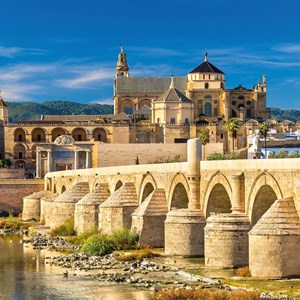
Córdoba: In Córdoba, you’ll join your Travel Director for a short orientation that helps fix the city on the map. Walk by the Roman bridge over the Guadalquivir, pass the old gateway towers and step into the historic center, where whitewashed houses, small squares and hidden patios show how this older part of the city fits together.
Córdoba: Visit the Mezquita with a local historian to trace how a mosque became a cathedral. You’ll step into a forest of striped arches and columns from the original Islamic building, then see later Christian additions including the central choir and chapels.
Madrid: Explore Madrid’s Old Quarter with a Local Expert who outlines how the district developed from a small medieval citadel into the center of Habsburg Madrid. You’ll see the compact street grid, market squares and civic buildings that shaped the early city, and trace how each layer of expansion created the foundations of the modern capital.
Valencia: Spend time with a chef in a family-run kitchen to see how Valencian paella is built from its base — the heat of the pan, the saffron stock, the type of rice and the order ingredients go in. Afterwards, sit down to eat the finished paella, tasting the layered flavor and socarrat crust you’ve just watched being made.
Madrid: Sit down to dinner with your Travel Director and fellow travelers at a local restaurant.
Granada: Visit the Alhambra Palace with a Local Expert and walk through its courtyards, carved plasterwork and palace rooms from the Nasrid period. You’ll see how water channels, gardens and intricate detail define the complex, and how this hilltop site shaped Granada’s cultural and political story for centuries.
Madrid: Visit the Prado Museum with an art historian who places key works within their historical setting. With your historian’s expert guidance, you’ll examine paintings by Velázquez, Goya, Titian and Rubens, noting their connection to royal patronage and the broader European tradition. Learn how the museum, founded in 1819, became a principal repository for Spain’s royal collections and major works from across the continent.
Seville: Join a guided walk through the Santa Cruz quarter, following a street pattern shaped by Seville’s medieval Jewish community until the 14th century. You’ll navigate narrow lanes, enclosed courtyards and small plazas reflect the district’s earlier layout, with surviving architectural elements that point to the neighborhood’s social and cultural history within the wider city.
Seville: Take a panoramic drive around Seville to observe the city’s main districts and landmarks, including the riverfront near Torre del Oro, the avenues created for the 1929 Ibero-American Exposition and the open spaces around María Luisa Park.
Choose between two carefully selected activities
Seville: Join a guided walk through the Santa Cruz quarter, following a street pattern shaped by Seville’s medieval Jewish community until the 14th century. You’ll navigate narrow lanes, enclosed courtyards and small plazas reflect the district’s earlier layout, with surviving architectural elements that point to the neighborhood’s social and cultural history within the wider city.
Seville: Take a panoramic drive around Seville to observe the city’s main districts and landmarks, including the riverfront near Torre del Oro, the avenues created for the 1929 Ibero-American Exposition and the open spaces around María Luisa Park.
From USD$3146¥21218Rs.299959€2731C$4389$3496¥23579Rs.333330€3035C$4877Save 10%
Barcelona: At La Pau, you’ll sit down to a seasonal Catalan menu in a restaurant built around social impact. Dishes are prepared and served by young people in training, many moving on from care or disrupted schooling. Paid work, mentoring and a clear structure help them gain skills in the kitchen and dining room as they move towards independent living. Your visit directly supports United Nations Sustainable Development Goal 10: Reduced Inequalities.
Seville: The Cristina Heeren Foundation promotes the teaching and preservation of flamenco and is supported by a TreadRight Foundation grant. Meet students, learn a few basic steps and watch them perform, gaining insight into how the school trains young artists in guitar, singing and dance. Your visit directly supports United Nations Sustainable Development Goal 4: Quality Education.
Barcelona: Explore Barcelona with a Local Expert who sets out the city’s shape from street level — the long run of Passeig de Gràcia, the sharp grid of the Eixample and the way the skyline shifts as the Sagrada Família comes into view. The route ties together the city’s Modernista detail and its ongoing architectural change.
Peñíscola: See Peñíscola’s 14th-century castle rising above the old town, set on a limestone headland that divides the shoreline.
Valencia: Get your bearings in Valencia’s Old City as your Travel Director points out the surviving medieval gateways and the street grid shaped by centuries of expansion.
Seville: Visit Seville Cathedral, completed in the 16th century and recognized as the largest Gothic cathedral in the world. Walk through its vast nave and chapels and view the Giralda, originally built as the minaret of the 12th-century Almohad mosque. The cathedral’s scale and layered construction show how the site developed from Islamic to Christian use.
Seville: Join a guided walk through the Santa Cruz quarter, following a street pattern shaped by Seville’s medieval Jewish community until the 14th century. You’ll navigate narrow lanes, enclosed courtyards and small plazas reflect the district’s earlier layout, with surviving architectural elements that point to the neighborhood’s social and cultural history within the wider city.
Córdoba: In Córdoba, you’ll join your Travel Director for a short orientation that helps fix the city on the map. Walk by the Roman bridge over the Guadalquivir, pass the old gateway towers and step into the historic center, where whitewashed houses, small squares and hidden patios show how this older part of the city fits together.
Córdoba: Visit the Mezquita with a local historian to trace how a mosque became a cathedral. You’ll step into a forest of striped arches and columns from the original Islamic building, then see later Christian additions including the central choir and chapels.
Madrid: Explore Madrid’s Old Quarter with a Local Expert who outlines how the district developed from a small medieval citadel into the center of Habsburg Madrid. You’ll see the compact street grid, market squares and civic buildings that shaped the early city, and trace how each layer of expansion created the foundations of the modern capital.
Valencia: Spend time with a chef in a family-run kitchen to see how Valencian paella is built from its base — the heat of the pan, the saffron stock, the type of rice and the order ingredients go in. Afterwards, sit down to eat the finished paella, tasting the layered flavor and socarrat crust you’ve just watched being made.
Madrid: Sit down to dinner with your Travel Director and fellow travelers at a local restaurant.
Granada: Visit the Alhambra Palace with a Local Expert and walk through its courtyards, carved plasterwork and palace rooms from the Nasrid period. You’ll see how water channels, gardens and intricate detail define the complex, and how this hilltop site shaped Granada’s cultural and political story for centuries.
Madrid: Visit the Prado Museum with an art historian who places key works within their historical setting. With your historian’s expert guidance, you’ll examine paintings by Velázquez, Goya, Titian and Rubens, noting their connection to royal patronage and the broader European tradition. Learn how the museum, founded in 1819, became a principal repository for Spain’s royal collections and major works from across the continent.
Barcelona: At La Pau, you’ll sit down to a seasonal Catalan menu in a restaurant built around social impact. Dishes are prepared and served by young people in training, many moving on from care or disrupted schooling. Paid work, mentoring and a clear structure help them gain skills in the kitchen and dining room as they move towards independent living. Your visit directly supports United Nations Sustainable Development Goal 10: Reduced Inequalities.
Seville: The Cristina Heeren Foundation promotes the teaching and preservation of flamenco and is supported by a TreadRight Foundation grant. Meet students, learn a few basic steps and watch them perform, gaining insight into how the school trains young artists in guitar, singing and dance. Your visit directly supports United Nations Sustainable Development Goal 4: Quality Education.
Barcelona: Explore Barcelona with a Local Expert who sets out the city’s shape from street level — the long run of Passeig de Gràcia, the sharp grid of the Eixample and the way the skyline shifts as the Sagrada Família comes into view. The route ties together the city’s Modernista detail and its ongoing architectural change.
Peñíscola: See Peñíscola’s 14th-century castle rising above the old town, set on a limestone headland that divides the shoreline.
Valencia: Get your bearings in Valencia’s Old City as your Travel Director points out the surviving medieval gateways and the street grid shaped by centuries of expansion.
Seville: Visit Seville Cathedral, completed in the 16th century and recognized as the largest Gothic cathedral in the world. Walk through its vast nave and chapels and view the Giralda, originally built as the minaret of the 12th-century Almohad mosque. The cathedral’s scale and layered construction show how the site developed from Islamic to Christian use.
Córdoba: In Córdoba, you’ll join your Travel Director for a short orientation that helps fix the city on the map. Walk by the Roman bridge over the Guadalquivir, pass the old gateway towers and step into the historic center, where whitewashed houses, small squares and hidden patios show how this older part of the city fits together.
Córdoba: Visit the Mezquita with a local historian to trace how a mosque became a cathedral. You’ll step into a forest of striped arches and columns from the original Islamic building, then see later Christian additions including the central choir and chapels.
Madrid: Explore Madrid’s Old Quarter with a Local Expert who outlines how the district developed from a small medieval citadel into the center of Habsburg Madrid. You’ll see the compact street grid, market squares and civic buildings that shaped the early city, and trace how each layer of expansion created the foundations of the modern capital.
Valencia: Spend time with a chef in a family-run kitchen to see how Valencian paella is built from its base — the heat of the pan, the saffron stock, the type of rice and the order ingredients go in. Afterwards, sit down to eat the finished paella, tasting the layered flavor and socarrat crust you’ve just watched being made.
Madrid: Sit down to dinner with your Travel Director and fellow travelers at a local restaurant.
Granada: Visit the Alhambra Palace with a Local Expert and walk through its courtyards, carved plasterwork and palace rooms from the Nasrid period. You’ll see how water channels, gardens and intricate detail define the complex, and how this hilltop site shaped Granada’s cultural and political story for centuries.
Madrid: Visit the Prado Museum with an art historian who places key works within their historical setting. With your historian’s expert guidance, you’ll examine paintings by Velázquez, Goya, Titian and Rubens, noting their connection to royal patronage and the broader European tradition. Learn how the museum, founded in 1819, became a principal repository for Spain’s royal collections and major works from across the continent.
From USD$2723¥18366Rs.259628€2364C$3799$3026¥20409Rs.288517€2627C$4221Save 10%
Barcelona: At La Pau, you’ll sit down to a seasonal Catalan menu in a restaurant built around social impact. Dishes are prepared and served by young people in training, many moving on from care or disrupted schooling. Paid work, mentoring and a clear structure help them gain skills in the kitchen and dining room as they move towards independent living. Your visit directly supports United Nations Sustainable Development Goal 10: Reduced Inequalities.
Seville: The Cristina Heeren Foundation promotes the teaching and preservation of flamenco and is supported by a TreadRight Foundation grant. Meet students, learn a few basic steps and watch them perform, gaining insight into how the school trains young artists in guitar, singing and dance. Your visit directly supports United Nations Sustainable Development Goal 4: Quality Education.
Barcelona: Explore Barcelona with a Local Expert who sets out the city’s shape from street level — the long run of Passeig de Gràcia, the sharp grid of the Eixample and the way the skyline shifts as the Sagrada Família comes into view. The route ties together the city’s Modernista detail and its ongoing architectural change.
Peñíscola: See Peñíscola’s 14th-century castle rising above the old town, set on a limestone headland that divides the shoreline.
Valencia: Get your bearings in Valencia’s Old City as your Travel Director points out the surviving medieval gateways and the street grid shaped by centuries of expansion.
Seville: Visit Seville Cathedral, completed in the 16th century and recognized as the largest Gothic cathedral in the world. Walk through its vast nave and chapels and view the Giralda, originally built as the minaret of the 12th-century Almohad mosque. The cathedral’s scale and layered construction show how the site developed from Islamic to Christian use.
Córdoba: In Córdoba, you’ll join your Travel Director for a short orientation that helps fix the city on the map. Walk by the Roman bridge over the Guadalquivir, pass the old gateway towers and step into the historic center, where whitewashed houses, small squares and hidden patios show how this older part of the city fits together.
Córdoba: Visit the Mezquita with a local historian to trace how a mosque became a cathedral. You’ll step into a forest of striped arches and columns from the original Islamic building, then see later Christian additions including the central choir and chapels.
Madrid: Explore Madrid’s Old Quarter with a Local Expert who outlines how the district developed from a small medieval citadel into the center of Habsburg Madrid. You’ll see the compact street grid, market squares and civic buildings that shaped the early city, and trace how each layer of expansion created the foundations of the modern capital.
Valencia: Spend time with a chef in a family-run kitchen to see how Valencian paella is built from its base — the heat of the pan, the saffron stock, the type of rice and the order ingredients go in. Afterwards, sit down to eat the finished paella, tasting the layered flavor and socarrat crust you’ve just watched being made.
Madrid: Sit down to dinner with your Travel Director and fellow travelers at a local restaurant.
Granada: Visit the Alhambra Palace with a Local Expert and walk through its courtyards, carved plasterwork and palace rooms from the Nasrid period. You’ll see how water channels, gardens and intricate detail define the complex, and how this hilltop site shaped Granada’s cultural and political story for centuries.
Madrid: Visit the Prado Museum with an art historian who places key works within their historical setting. With your historian’s expert guidance, you’ll examine paintings by Velázquez, Goya, Titian and Rubens, noting their connection to royal patronage and the broader European tradition. Learn how the museum, founded in 1819, became a principal repository for Spain’s royal collections and major works from across the continent.
Barcelona: Explore Barcelona with a Local Expert who sets out the city’s shape from street level — the long run of Passeig de Gràcia, the sharp grid of the Eixample and the way the skyline shifts as the Sagrada Família comes into view. The route ties together the city’s Modernista detail and its ongoing architectural change.
Peñíscola: See Peñíscola’s 14th-century castle rising above the old town, set on a limestone headland that divides the shoreline.
Valencia: Get your bearings in Valencia’s Old City as your Travel Director points out the surviving medieval gateways and the street grid shaped by centuries of expansion.
Seville: Visit Seville Cathedral, completed in the 16th century and recognized as the largest Gothic cathedral in the world. Walk through its vast nave and chapels and view the Giralda, originally built as the minaret of the 12th-century Almohad mosque. The cathedral’s scale and layered construction show how the site developed from Islamic to Christian use.
Córdoba: In Córdoba, you’ll join your Travel Director for a short orientation that helps fix the city on the map. Walk by the Roman bridge over the Guadalquivir, pass the old gateway towers and step into the historic center, where whitewashed houses, small squares and hidden patios show how this older part of the city fits together.
Córdoba: Visit the Mezquita with a local historian to trace how a mosque became a cathedral. You’ll step into a forest of striped arches and columns from the original Islamic building, then see later Christian additions including the central choir and chapels.
Oviedo: Led by your Local Expert, see 1,000-year-old wall paintings in some of Europe's oldest churches. Admire the incredible altarpiece, one of the finest in Europe, when you visit the Cathedral of the Holy Savior.
Picos de Europa: Visit the holy cave of Covadonga and see the tomb of Pelayo who is celebrated for winning the Battle of Covadonga against the Muslim Moors in 722 and later became the first King of Asturias.
Picos de Europa: Venture into this magnificent national park to admire the stunning picturesque scenery and rocky trails.
Santillana del Mar: Step back in time when you visit this perfectly preserved and 'most beautiful village in Spain.'
Bilbao: See the spectacular modern Guggenheim Museum designed by Frank Gehry and sites of this Basque region gem during your orientation with your Travel Director.
Getaria: See the rock known as El Ratón or the mouse.
San Sebastián: Led by your Local Expert, enjoy a guided walking tour of the Old Quarter including Plaza de la Constitucion.
Pamplona: The city is home to Cafe Iruña, a favorite of Ernest Hemingway.
Valencia: Spend time with a chef in a family-run kitchen to see how Valencian paella is built from its base — the heat of the pan, the saffron stock, the type of rice and the order ingredients go in. Afterwards, sit down to eat the finished paella, tasting the layered flavor and socarrat crust you’ve just watched being made.
Barcelona: Your final evening brings the group together around the table in Barcelona. It’s a chance to share dinner in the Catalan capital, reminisce over the days you’ve traveled and mark the end of your journey across Spain and Portugal with one last meal together.
Granada: Visit the Alhambra Palace with a Local Expert and walk through its courtyards, carved plasterwork and palace rooms from the Nasrid period. You’ll see how water channels, gardens and intricate detail define the complex, and how this hilltop site shaped Granada’s cultural and political story for centuries.
Madrid: Visit the Prado Museum with an art historian who places key works within their historical setting. With your historian’s expert guidance, you’ll examine paintings by Velázquez, Goya, Titian and Rubens, noting their connection to royal patronage and the broader European tradition. Learn how the museum, founded in 1819, became a principal repository for Spain’s royal collections and major works from across the continent.
Seville: The Cristina Heeren Foundation promotes the teaching and preservation of flamenco and is supported by a TreadRight Foundation grant. Meet students, learn a few basic steps and watch them perform, gaining insight into how the school trains young artists in guitar, singing and dance. Your visit directly supports United Nations Sustainable Development Goal 4: Quality Education.
Gijón: Meet locals for a delicious Farm-to-Table meal of locally sourced produce that has been prepared just for you. Your visit directly supports United Nations Sustainable Development Goal 12: Responsible Consumption and Production.
Seville: Join a guided walk through the Santa Cruz quarter, following a street pattern shaped by Seville’s medieval Jewish community until the 14th century. You’ll navigate narrow lanes, enclosed courtyards and small plazas reflect the district’s earlier layout, with surviving architectural elements that point to the neighborhood’s social and cultural history within the wider city.
Seville: Take a panoramic drive around Seville to observe the city’s main districts and landmarks, including the riverfront near Torre del Oro, the avenues created for the 1929 Ibero-American Exposition and the open spaces around María Luisa Park.
Santiago de Compostela: Join a city tour with a Local Expert and visit Praza do Obradoiro to admire the cathedral facade festooned with architectural frills.
Santiago de Compostela: Embark on a scenic walk on part of the Way of St. James with a Local Expert, through parks and gardens that transform with the seasons.
Choose between two carefully selected activities
Seville: Join a guided walk through the Santa Cruz quarter, following a street pattern shaped by Seville’s medieval Jewish community until the 14th century. You’ll navigate narrow lanes, enclosed courtyards and small plazas reflect the district’s earlier layout, with surviving architectural elements that point to the neighborhood’s social and cultural history within the wider city.
Seville: Take a panoramic drive around Seville to observe the city’s main districts and landmarks, including the riverfront near Torre del Oro, the avenues created for the 1929 Ibero-American Exposition and the open spaces around María Luisa Park.
Santiago de Compostela: Join a city tour with a Local Expert and visit Praza do Obradoiro to admire the cathedral facade festooned with architectural frills.
Santiago de Compostela: Embark on a scenic walk on part of the Way of St. James with a Local Expert, through parks and gardens that transform with the seasons.
Barcelona: Explore Barcelona with a Local Expert who sets out the city’s shape from street level — the long run of Passeig de Gràcia, the sharp grid of the Eixample and the way the skyline shifts as the Sagrada Família comes into view. The route ties together the city’s Modernista detail and its ongoing architectural change.
Peñíscola: See Peñíscola’s 14th-century castle rising above the old town, set on a limestone headland that divides the shoreline.
Valencia: Get your bearings in Valencia’s Old City as your Travel Director points out the surviving medieval gateways and the street grid shaped by centuries of expansion.
Seville: Visit Seville Cathedral, completed in the 16th century and recognized as the largest Gothic cathedral in the world. Walk through its vast nave and chapels and view the Giralda, originally built as the minaret of the 12th-century Almohad mosque. The cathedral’s scale and layered construction show how the site developed from Islamic to Christian use.
Seville: Join a guided walk through the Santa Cruz quarter, following a street pattern shaped by Seville’s medieval Jewish community until the 14th century. You’ll navigate narrow lanes, enclosed courtyards and small plazas reflect the district’s earlier layout, with surviving architectural elements that point to the neighborhood’s social and cultural history within the wider city.
Córdoba: In Córdoba, you’ll join your Travel Director for a short orientation that helps fix the city on the map. Walk by the Roman bridge over the Guadalquivir, pass the old gateway towers and step into the historic center, where whitewashed houses, small squares and hidden patios show how this older part of the city fits together.
Córdoba: Visit the Mezquita with a local historian to trace how a mosque became a cathedral. You’ll step into a forest of striped arches and columns from the original Islamic building, then see later Christian additions including the central choir and chapels.
Oviedo: Led by your Local Expert, see 1,000-year-old wall paintings in some of Europe's oldest churches. Admire the incredible altarpiece, one of the finest in Europe, when you visit the Cathedral of the Holy Savior.
Picos de Europa: Visit the holy cave of Covadonga and see the tomb of Pelayo who is celebrated for winning the Battle of Covadonga against the Muslim Moors in 722 and later became the first King of Asturias.
Picos de Europa: Venture into this magnificent national park to admire the stunning picturesque scenery and rocky trails.
Santillana del Mar: Step back in time when you visit this perfectly preserved and 'most beautiful village in Spain.'
Bilbao: See the spectacular modern Guggenheim Museum designed by Frank Gehry and sites of this Basque region gem during your orientation with your Travel Director.
Getaria: See the rock known as El Ratón or the mouse.
San Sebastián: Led by your Local Expert, enjoy a guided walking tour of the Old Quarter including Plaza de la Constitucion.
Pamplona: The city is home to Cafe Iruña, a favorite of Ernest Hemingway.
Valencia: Spend time with a chef in a family-run kitchen to see how Valencian paella is built from its base — the heat of the pan, the saffron stock, the type of rice and the order ingredients go in. Afterwards, sit down to eat the finished paella, tasting the layered flavor and socarrat crust you’ve just watched being made.
Barcelona: Your final evening brings the group together around the table in Barcelona. It’s a chance to share dinner in the Catalan capital, reminisce over the days you’ve traveled and mark the end of your journey across Spain and Portugal with one last meal together.
Granada: Visit the Alhambra Palace with a Local Expert and walk through its courtyards, carved plasterwork and palace rooms from the Nasrid period. You’ll see how water channels, gardens and intricate detail define the complex, and how this hilltop site shaped Granada’s cultural and political story for centuries.
Madrid: Visit the Prado Museum with an art historian who places key works within their historical setting. With your historian’s expert guidance, you’ll examine paintings by Velázquez, Goya, Titian and Rubens, noting their connection to royal patronage and the broader European tradition. Learn how the museum, founded in 1819, became a principal repository for Spain’s royal collections and major works from across the continent.
Seville: The Cristina Heeren Foundation promotes the teaching and preservation of flamenco and is supported by a TreadRight Foundation grant. Meet students, learn a few basic steps and watch them perform, gaining insight into how the school trains young artists in guitar, singing and dance. Your visit directly supports United Nations Sustainable Development Goal 4: Quality Education.
Gijón: Meet locals for a delicious Farm-to-Table meal of locally sourced produce that has been prepared just for you. Your visit directly supports United Nations Sustainable Development Goal 12: Responsible Consumption and Production.
Santiago de Compostela: Join a city tour with a Local Expert and visit Praza do Obradoiro to admire the cathedral facade festooned with architectural frills.
Santiago de Compostela: Embark on a scenic walk on part of the Way of St. James with a Local Expert, through parks and gardens that transform with the seasons.
Choose between two carefully selected activities
Santiago de Compostela: Join a city tour with a Local Expert and visit Praza do Obradoiro to admire the cathedral facade festooned with architectural frills.
Santiago de Compostela: Embark on a scenic walk on part of the Way of St. James with a Local Expert, through parks and gardens that transform with the seasons.
Barcelona: Explore Barcelona with a Local Expert who sets out the city’s shape from street level — the long run of Passeig de Gràcia, the sharp grid of the Eixample and the way the skyline shifts as the Sagrada Família comes into view. The route ties together the city’s Modernista detail and its ongoing architectural change.
Peñíscola: See Peñíscola’s 14th-century castle rising above the old town, set on a limestone headland that divides the shoreline.
Valencia: Get your bearings in Valencia’s Old City as your Travel Director points out the surviving medieval gateways and the street grid shaped by centuries of expansion.
Seville: Visit Seville Cathedral, completed in the 16th century and recognized as the largest Gothic cathedral in the world. Walk through its vast nave and chapels and view the Giralda, originally built as the minaret of the 12th-century Almohad mosque. The cathedral’s scale and layered construction show how the site developed from Islamic to Christian use.
Córdoba: In Córdoba, you’ll join your Travel Director for a short orientation that helps fix the city on the map. Walk by the Roman bridge over the Guadalquivir, pass the old gateway towers and step into the historic center, where whitewashed houses, small squares and hidden patios show how this older part of the city fits together.
Córdoba: Visit the Mezquita with a local historian to trace how a mosque became a cathedral. You’ll step into a forest of striped arches and columns from the original Islamic building, then see later Christian additions including the central choir and chapels.
Oviedo: Led by your Local Expert, see 1,000-year-old wall paintings in some of Europe's oldest churches. Admire the incredible altarpiece, one of the finest in Europe, when you visit the Cathedral of the Holy Savior.
Picos de Europa: Visit the holy cave of Covadonga and see the tomb of Pelayo who is celebrated for winning the Battle of Covadonga against the Muslim Moors in 722 and later became the first King of Asturias.
Picos de Europa: Venture into this magnificent national park to admire the stunning picturesque scenery and rocky trails.
Santillana del Mar: Step back in time when you visit this perfectly preserved and 'most beautiful village in Spain.'
Bilbao: See the spectacular modern Guggenheim Museum designed by Frank Gehry and sites of this Basque region gem during your orientation with your Travel Director.
Getaria: See the rock known as El Ratón or the mouse.
San Sebastián: Led by your Local Expert, enjoy a guided walking tour of the Old Quarter including Plaza de la Constitucion.
Pamplona: The city is home to Cafe Iruña, a favorite of Ernest Hemingway.
Valencia: Spend time with a chef in a family-run kitchen to see how Valencian paella is built from its base — the heat of the pan, the saffron stock, the type of rice and the order ingredients go in. Afterwards, sit down to eat the finished paella, tasting the layered flavor and socarrat crust you’ve just watched being made.
Barcelona: Your final evening brings the group together around the table in Barcelona. It’s a chance to share dinner in the Catalan capital, reminisce over the days you’ve traveled and mark the end of your journey across Spain and Portugal with one last meal together.
Granada: Visit the Alhambra Palace with a Local Expert and walk through its courtyards, carved plasterwork and palace rooms from the Nasrid period. You’ll see how water channels, gardens and intricate detail define the complex, and how this hilltop site shaped Granada’s cultural and political story for centuries.
Madrid: Visit the Prado Museum with an art historian who places key works within their historical setting. With your historian’s expert guidance, you’ll examine paintings by Velázquez, Goya, Titian and Rubens, noting their connection to royal patronage and the broader European tradition. Learn how the museum, founded in 1819, became a principal repository for Spain’s royal collections and major works from across the continent.
Seville: The Cristina Heeren Foundation promotes the teaching and preservation of flamenco and is supported by a TreadRight Foundation grant. Meet students, learn a few basic steps and watch them perform, gaining insight into how the school trains young artists in guitar, singing and dance. Your visit directly supports United Nations Sustainable Development Goal 4: Quality Education.
Gijón: Meet locals for a delicious Farm-to-Table meal of locally sourced produce that has been prepared just for you. Your visit directly supports United Nations Sustainable Development Goal 12: Responsible Consumption and Production.
Seville: Join a guided walk through the Santa Cruz quarter, following a street pattern shaped by Seville’s medieval Jewish community until the 14th century. You’ll navigate narrow lanes, enclosed courtyards and small plazas reflect the district’s earlier layout, with surviving architectural elements that point to the neighborhood’s social and cultural history within the wider city.
Seville: Take a panoramic drive around Seville to observe the city’s main districts and landmarks, including the riverfront near Torre del Oro, the avenues created for the 1929 Ibero-American Exposition and the open spaces around María Luisa Park.
Santiago de Compostela: Join a city tour with a Local Expert and visit Praza do Obradoiro to admire the cathedral facade festooned with architectural frills.
Santiago de Compostela: Embark on a scenic walk on part of the Way of St. James with a Local Expert, through parks and gardens that transform with the seasons.
Choose between two carefully selected activities
Seville: Join a guided walk through the Santa Cruz quarter, following a street pattern shaped by Seville’s medieval Jewish community until the 14th century. You’ll navigate narrow lanes, enclosed courtyards and small plazas reflect the district’s earlier layout, with surviving architectural elements that point to the neighborhood’s social and cultural history within the wider city.
Seville: Take a panoramic drive around Seville to observe the city’s main districts and landmarks, including the riverfront near Torre del Oro, the avenues created for the 1929 Ibero-American Exposition and the open spaces around María Luisa Park.
Santiago de Compostela: Join a city tour with a Local Expert and visit Praza do Obradoiro to admire the cathedral facade festooned with architectural frills.
Santiago de Compostela: Embark on a scenic walk on part of the Way of St. James with a Local Expert, through parks and gardens that transform with the seasons.